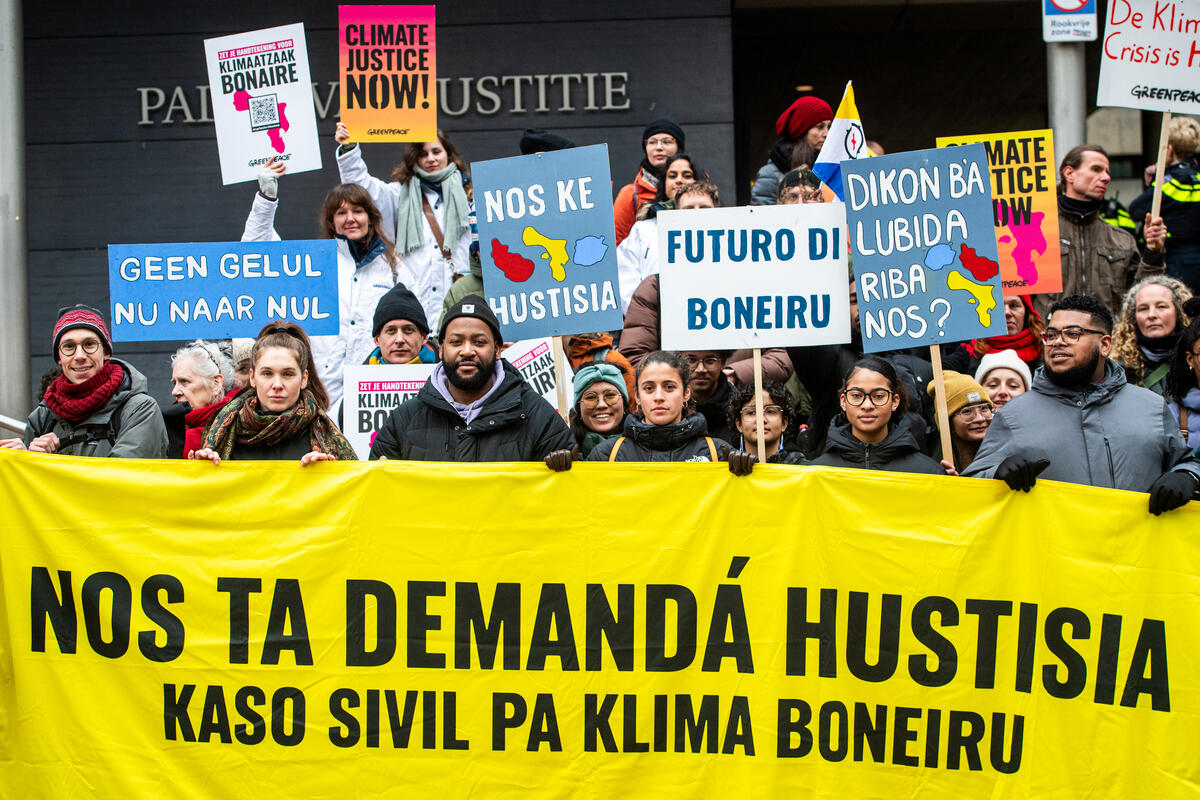
The Dutch government's climate policy violates the human rights of Bonaire's residents and discriminates against them. This was yesterday's ruling by the District Court of The Hague in the climate case brought against the Dutch government by eight residents of Bonaire and Greenpeace Netherlands. The court ordered the State of the Netherlands to develop a climate plan, and take measures by 2030 to protect Bonaire from the climate crisis. This is the first time a European court has imposed protective measures on a country. The government must also set new binding climate targets for the entire Dutch economy within 18 months, to reduce greenhouse gas emissions and make a fair contribution to the target of a maximum of 1.5 degrees of global warming.
The court noted that people on Bonaire are suffering greatly from climate change and that the State of the Netherlands has known for decades that Bonaire is particularly vulnerable. It ruled that the State of the Netherlands has failed to take timely and appropriate measures: temperatures are already "unhealthily high," flooding is increasing, and by 2050, part of Bonaire could be submerged. The court also paid close attention to the impact on the unique culture of the people of Bonaire. Climate change threatens tangible heritage, such as the slave huts, as well as traditional professions like fishing and agriculture. Many people on Bonaire live in poverty and are particularly vulnerable to the consequences of climate change. A protection plan must take all these elements into account and offer a level of protection appropriate to the serious situation on Bonaire.
This case sets a precedent of global relevance. It is the first time in Europe that a court has ruled that a country must take concrete measures to protect people from the effects of climate change. The International Court of Justice in The Hague previously ruled that states must limit global warming to 1.5 degrees Celsius and that their climate plans must demonstrate maximum ambition, taking into account historical emissions and prosperity levels. This is the first climate case in which these international rulings have been applied.
The residents of Bonaire and Greenpeace Netherlands are being assisted in this case by a team led by Emiel Jurjens (Prakken d'Oliveira) and Michael Bacon (Kennedy Van der Laan).
Annexes
- Rechtbank Den Haag 28 januari 2026, ECLI:NL:RBDHA:2026:1344 (judgment in Dutch)
- Rechtbank Den Haag 28 januari 2026, ECLI:NL:RBDHA:2026:1347 (judgment in English)
- Rechtbank Den Haag 28 januari 2026, ECLI:NL:RBDHA:2026:1348 (judgment in Papiamento)